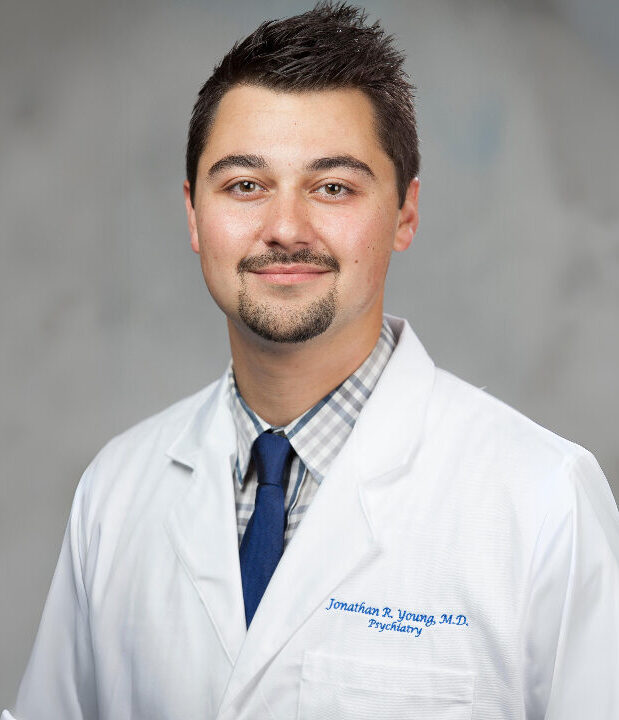
Dr. Jonathan Young’s career in interventional psychiatry was shaped by both scientific legacy and personal inspiration. His mother, Anne M. Young, is a child psychologist turned real estate developer in upstate New York. His father, the late Robert B. Young, MD, was a child and adolescent psychiatrist and one of the early clinical pioneers of transcranial magnetic stimulation (TMS). Studying the scientific literature on TMS in the late 1980s and early 1990s, Dr. Young’s father developed several innovative patents in the field. Introduced to TMS through this work in the early 2000s, Dr. Young resolved to carry the legacy forward by advancing the science and accessibility of brain stimulation.
He earned his undergraduate degree from New York University, with a major in Psychology and minors in Physics and Chemistry. During this time, he was mentored by Pascal Wallisch, PhD and began formal TMS training at Columbia University/New York State Psychiatric Institute under Sarah “Holly” Lisanby, MD. For several years, he also conducted epilepsy-focused fMRI research under Thomas Thesen, PhD at NYU Langone’s Cognitive Neurophysiology Lab, and worked at a prominent HIV/AIDS clinic in Manhattan under Paul C. Bellman, MD.
Dr. Young received his MD from Stony Brook University School of Medicine, where he was mentored by Laura Fochtmann, MD, MBI and Adeeb Yacoub, MD, among others. In 2015, he completed a year-long position as a Visiting Graduate Student at Duke University, coordinating clinical trials using TMS and transcranial direct current stimulation (tDCS) under the guidance of Drs. Lisanby, Andrew Krystal, Mustafa Husain, Shawn McClintock and Angel Peterchev.
In 2016, he matched at Duke University Hospital for a research-track general psychiatry residency training program, completing rotations at Duke Regional, Durham VA Medical Center, and Central Regional Hospital. In addition to emergency, inpatient, outpatient, and consult-liaison psychiatry, Dr. Young pursued additional training in pain management, weight loss, sleep medicine, and addictions. He also earned additional certification in electroconvulsive therapy (ECT) under Richard Weiner, and successfully competed for research awards under Greg Appelbaum, PhD.
Following residency graduation in 2020, he completed a Neurosciences Medicine Fellowship at the Duke Clinical Research Institute, participated in the NIH-Duke Clinical Research Training Program, and served as a VA Advanced Mental Illness Research and Treatment Fellow in the Traumatic Stress and Health Laboratory, working with renowned investigators including Profs. Jean Beckham, Scott Moore, Eric Dedert, and Merideth Addicott.
Dr. Young has been a federally funded investigator since 2021 and currently holds an academic appointment as Medical Assistant Professor of Psychiatry & Behavioral Sciences at Duke University School of Medicine. He leads clinical research on multimodal brain stimulation protocols for smoking cessation, specifically tailored to Veterans with posttraumatic stress disorder (PTSD).
The founding of Synaptiq Psychiatry reflects Dr. Young’s lifelong dedication to neuromodulation, commitment to innovative and accessible mental health care, and a deeply personal family legacy in brain stimulation science. His clinical work integrates cutting-edge interventional psychiatry—including mobile and in-home TMS—with evidence-based psychopharmacology and concierge-style telepsychiatry.
Select Publications
- Dubljević, V. and Young, JR. (Eds) (2025). TMS and Neuroethics, Cham: Springer/Nature.
- Young, J. R., Evans, M. K., Hwang, J., Kritzer, M. D., Kellner, C. H., & Weiner, R. D. (2024). Electroconvulsive therapy changes immunological markers in patients with major depressive disorder: a scoping review. The Journal of ECT, 40(4), 232-239. https://doi.org/10.1097/YCT.0000000000001021
- Young, J. R., Galla, J. T., & Appelbaum, L. G. (2021). Transcranial Magnetic Stimulation Treatment for Smoking Cessation: An Introduction for Primary Care Clinicians. The American Journal of Medicine, 134(11), 1339–1343. https://doi.org/10.1016/j.amjmed.2021.06.037
- Young, J. R., Yanagihara, A., Dew, R., & Kollins, S. H. (2021). Pharmacotherapy for preschool children with attention deficit hyperactivity disorder (ADHD): Current status and future directions. CNS drugs, 35(4), 403-424. https://doi.org/10.1007/s40263-021-00806-z
- Young, J. R., Smani, S. A., Mischel, N. A., Kritzer, M. D., Appelbaum, L. G., & Patkar, A. A. (2020). Non-invasive brain stimulation modalities for the treatment and prevention of opioid use disorder: a systematic review of the literature. Journal of Addictive Diseases, 38(2), 186–199. https://doi.org/10.1080/10550887.2020.1736756
- Young, J. R., Rozkov, A., Li, Z., Young, O., Barber, T., & Wallisch, P. (2014). Subcranial magnetic stimulation: a novel method of focal, non-invasive deep brain neuromodulation for the treatment of post-traumatic stress disorder. Brain Stimulation: Basic, Translational, and Clinical Research in Neuromodulation, 7(2), e15-e16. https://doi.org/10.1016/j.brs.2014.01.054
Dr. Young is an employee of the Department of Veterans Affairs. Synaptiq Psychiatry is a private entity, not endorsed by, affiliated with, or sanctioned by the VA. The views and services provided at Synaptiq Psychiatry are strictly in a personal capacity and do not represent the Department of Veterans Affairs or the U.S. Government.